Sri Lanka - the Switzerland of India

Sri Lanka, formerly Ceylon, has always fascinated me.
How exotic the name alone sounds – “Ceylon.” A green jewel in the azure ocean south of India. Among expats in Delhi, it is often referred to as the Switzerland of India, and the comparison is not as far-fetched as it may sound.
As soon as we leave the airport in Colombo, we notice it immediately: far less litter, and everything feels somehow more orderly. Lanes are respected, and the constant honking that accompanies you everywhere in Delhi is conspicuously absent.
We drive to Tangalle, at the southern tip of the island. Away from the tourist crowds, we have booked a homestay. To welcome us, we are given a fresh coconut. To my irritation, it is yellow rather than green, as in Delhi. It tastes a little sweeter too. Apparently, it is the riper version.
The next morning, we have breakfast at the Lobster Pot, a small, family-run restaurant. There is omelette, toast, and a large pot of coffee—which turns out to be thin filter coffee. As spoiled espresso drinkers, our caffeine needs are nowhere near satisfied. But we have our feet in the sand and a wonderful view of the small bay. That makes up for it. You can’t have everything.
Re-energised, we set off for the nearby beach: Silent Beach.
The waves crashing ashore are so powerful that the sound of the sea is anything but soothing. It is a loud, relentless roar, constantly reminding you how dangerous the ocean really is. I wonder why this beach is called Silent Beach when it is anything but silent.

The drop-off into the sea is quite steep, indicating strong waves with a powerful undertow. This is not a beach for relaxed swimming. I decide to stay out of the water. Our young son, on the other hand, is thrilled by the idea of taking on the waves. Holding my husband’s hand, he enthusiastically throws himself into the surf. I can see my husband tightening his grip on our son’s arm in a vice-like hold, looking anything but relaxed. He is trying to prevent both himself and our child from being dragged out to sea. Meanwhile, our son is having the time of his life—after all, his strong father is watching over him.
For my husband, the situation increasingly becomes a test of endurance. It culminates when two elderly women underestimate the waves, are knocked over, and dragged into the sea, as if into the jaws of a giant creature. They scream in panic, but no one can hear them—the roar of the ocean swallows every sound. Only my husband, standing nearby, notices what is happening. He pushes our son towards the shore and reaches out a hand to each of the women. Gratefully, they let themselves be pulled to safety.
We are shaken. There is neither a lifeguard nor a warning sign on the beach. Had my husband not been there by chance, the women would almost certainly not have been able to save themselves. Later, we research and learn that fatal swimming accidents occur repeatedly along Sri Lanka’s coast. We will not be swimming at this beach again.
In the evening, we head to a hotel said to serve good stone-oven pizza. It sits on a hill. We travel in a tuk-tuk that is clearly not the latest model. As we climb, the vehicle slows more and more, and I start to fear we will come to a complete stop. Decisively, my husband gets out and pushes the tuk-tuk so it can make it up the hill. The young driver apologises: “Very big mountain.” Given the modest size of the hill, this is so absurd that I can only laugh. My husband is a hero for the second time that day.
After all this excitement, we need some relaxation. We book a Shirodara, the Ayurvedic forehead oil treatment. Warm oil is poured over our foreheads for forty-five minutes. While I emerge deeply relaxed, my husband behaves like a wound-up Duracell bunny, fidgeting next to me as we drink our tea. It both amuses and amazes me how differently the same therapy can affect people.
We continue along the coast from the picturesque harbour town of Galle to Mirissa. On the way, we spot the wooden stilts of the stilt fishermen rising out of the sea. I want to take a closer look. In the shade on the beach, the fishermen rest in hammocks. For a small fee, they are happy to climb onto their stilts and pose for a photo. One of them even catches a fish—only for it to be immediately stolen by a seagull. Soon, countless gulls circle the fishermen, screeching excitedly and hoping for more. What a spectacle. The real skill here seems not only to be catching a fish, but also defending it against the cheeky seagulls.

Fishing from these stilt-like poles is not the only curious method here. The traditional fishing boats are so narrow—barely two hands wide—that it seems impossible to sit in them at all. Without their outriggers, they would capsize immediately. Yet they are still used for fishing. I wonder whether the fishermen stand in them. Perhaps their narrow design prevents too much water from sloshing in, given the strong swell off Sri Lanka’s coast. It is astonishing how adaptable humans can be.
Mirissa is famous for its sea turtles and whale watching.
At Turtle Beach, we go snorkelling with a local operator. We enter the water directly from the shore. The waves are strong, and our guide tows us into a small bay using a lifebuoy. The water is shallow—perhaps two to three metres deep. We look down at the seabed, and there she is: a large sea turtle calmly grazing on seagrass. How beautiful. The highlight is when the turtle surfaces. She is so close that I can look straight into her eyes. What an experience. We see two more large green sea turtles, seemingly unfazed by the commotion around them. The beach truly deserves its name.

On recommendation, we book a whale-watching tour with a sustainable operator who works with the local university. We set off before sunrise. At registration, every passenger is given a preventative tablet for seasickness. I feel slightly uneasy—the Indian Ocean is not known for being calm.
We head out into the open ocean in a small boat. The chances of seeing whales in Mirissa are high, as the continental shelf drops off just a few kilometres offshore. The thought of hundreds of metres of depth beneath us is unsettling.
The weather is beautiful. Rainbows dance in the spray. On board, we have breakfast: coffee, fruit, and even freshly made omelette. Not far away, I spot one of the traditional, brightly painted fishing boats. The fisherman waves at me, and I wave back. In the distance, dolphins appear. That alone would have made the tour worthwhile.
Then suddenly, excitement on board: whales in sight. Everyone scans the surface of the water. I let my gaze drift over the waves—and there he is. First a small spout, then a grey back with a dorsal fin disappearing into the swell. Wow. I have actually seen a whale. It is a Bryde’s whale, a smaller relative of the blue whale that lives year-round in tropical waters. Shortly afterwards, more excitement: another whale on the other side of the boat. Again, we watch intently. Again, a brief appearance—spout, grey back, gone. The whale reveals little of itself. Still, it is extraordinary to see such a gigantic animal in the wild.
Six other boats are out whale watching alongside us. All follow the two whales, each trying to secure the best position for a close view. The scene feels uncomfortably like a whale hunt. Only the harpoons are missing.
After we have spotted the whale a few times, it dives. Whales escape such situations by retreating into deeper waters. That reassures me.
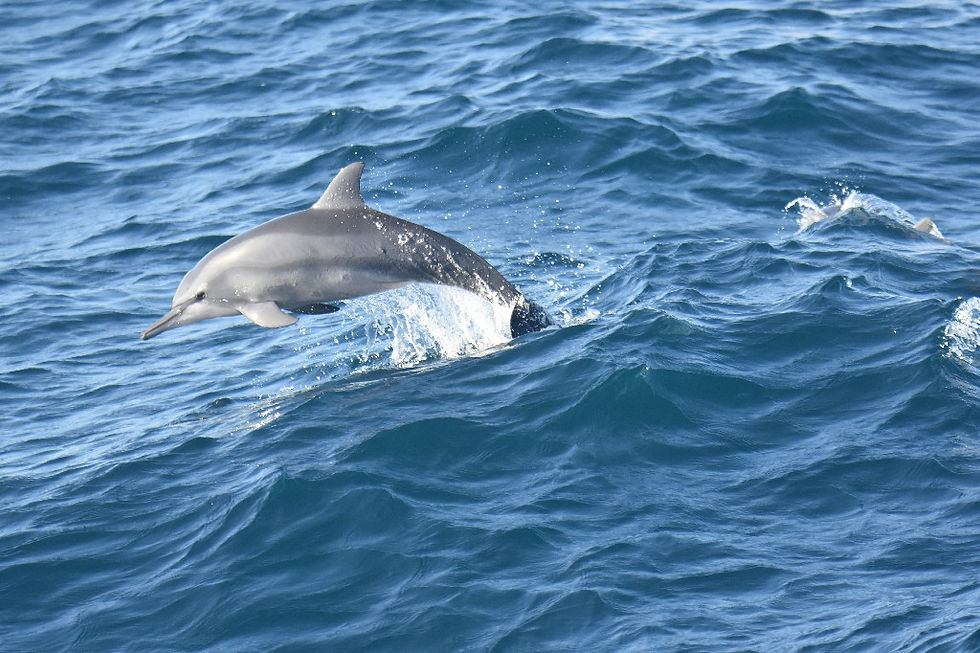
On our way back, we encounter a large pod of spinner dolphins, some swimming right in front of our boat. They are lightning-fast and perform graceful leaps. The water seems to boil. Suddenly, fish leap out of the sea, and I realise we are witnessing a hunt. The dolphins herd the fish towards the surface, leaving them no escape but to jump.
The dolphins are the highlight of the tour for me. We observe them behaving naturally, and unlike the whales, they do not seem disturbed by the presence of our boat.
As much as I love observing animals in their natural habitat, when it starts to feel like a driven hunt rather than a respectful observation, the experience leaves a bitter aftertaste.
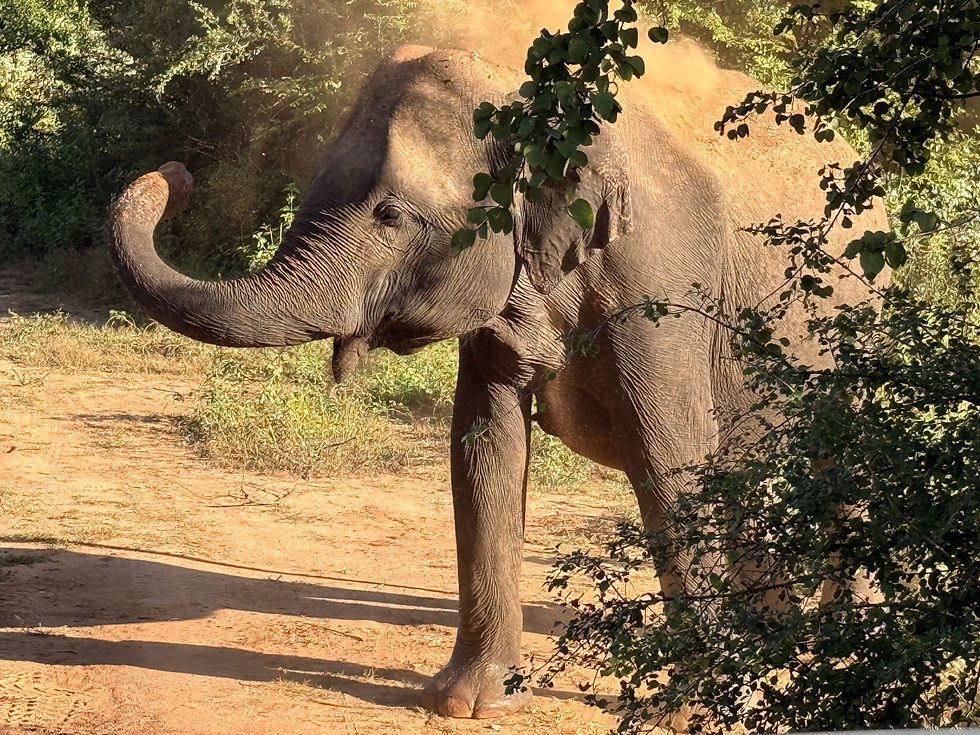
Despite my ambivalent feelings about the ocean safari, we visit Udawalawe National Park, which promises a 100 percent chance of seeing elephants. Indeed, before we even enter the park, I spot a large bull standing right by the fence. We watch elephants feeding in small family groups and observe a pregnant cow taking a sand bath, barely a metre away from our jeep. Crocodiles lounge lazily by the water, water buffalo wallow, and axis deer graze calmly near the entrance. The animals seem completely unbothered by our presence. I am glad we did this safari. Never before have I seen elephants in the wild from such close range.
In the evening, we sit at a beach bar. As I stare into the fire and listen to the waves crashing ashore, I reflect on the comparison with Switzerland.

Yes, Sri Lanka is cleaner than India. More orderly. More expensive. The people are incredibly friendly and eager to please. But beneath the surface, I sense a tension I do not know from India. Every family seems to be seeking its fortune in tourism—a homestay here, a small restaurant there. They court the few tourists in the south almost desperately.
Cars and cigarettes cost a fortune. Transport costs are absurdly high. Everything is regulated, taxed, organised. Swiss prices, indeed—but without Swiss salaries.
And yet, the island is a treasure for anyone who loves nature: green sea turtles, Bryde’s whales, elephants bathing in sand. And we did not even explore the highlands with their tea plantations.
The Switzerland of India? Perhaps.
But one with challenges of its own.
And with much stronger waves.



Comments